Our Man in Mexico: Winston Scott and the Hidden History of the CIA by Morley Jefferson
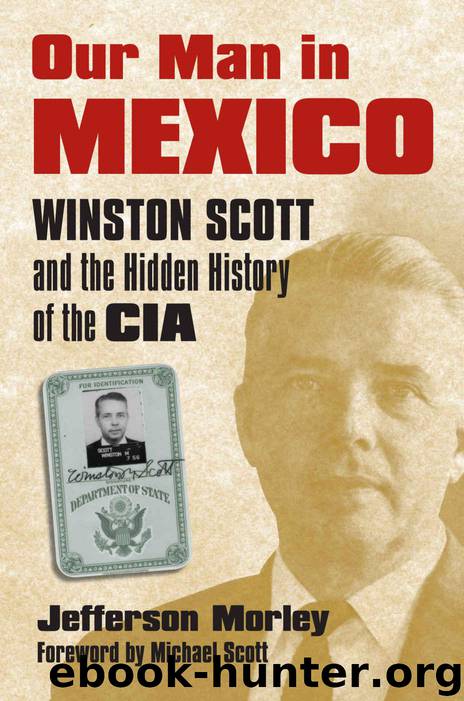
Author:Morley, Jefferson [Morley, Jefferson]
Language: eng
Format: azw3, epub
Publisher: University Press of Kansas
Published: 2014-02-03T05:00:00+00:00
Every piece of information concerning Lee Harvey Oswald was reported immediately after it was received to: US Ambassador Thomas C. Mann, by memorandum; the FBI Chief in Mexico, by memorandum; and to my headquarters by cable; and included in each and every one of these reports was the entire conversation Oswald had, so far as it was known. These reports were made on all his contacts with both the Cuban Consulate and with the Soviets.
Because we thought at first that Lee Harvey Oswald might be a dangerous potential defector from the USA to the Soviet Union, he was of great interest to us, so we kept a special watch on him and his activities. He was observed on all his visits to each of the two communist embassies; and his conversations with personnel of these embassies were studied in detail, so far as we knew them.
Win’s account is far from infallible. He wrote from memory, not from the documents, and it showed. He sometimes scrambled the sequence of events in Oswald’s trip. He got some details wrong. He wrote “November 23” when referring to the events of November 22. Anne Goodpasture noted that his reporting to headquarters sometimes exaggerated his accomplishments. But on the question of whether Oswald was photographed during his visits to the Cuban embassy in September 1963, a wide variety of evidence supports Win’s version of events.
The station’s program of photographic surveillance of the Cuban diplomatic compound in Mexico City, called LIERODE, was housed in an apartment across the street. David Phillips, as the chief of Cuba operations, had responsibility for reviewing the photographs of all visitors and deciding if their contacts with the Cubans warranted further action. In a September 1963 report to the photographic branch at headquarters, Win noted that photographic surveillance of the Cubans had been expanded on September 27, the very day of Oswald’s visit. Up until then, the observation post had only one employee, who took pictures of visitors coming and going through the embassy’s main gate. But then the Cubans reopened the public entrance to the consulate, halfway down the block. A lone photographer could not take pictures of visitors to both the embassy’s main gate and the consulate door, so a second camera, with a shutter device called a VLS-2 that automatically snapped a picture whenever someone came into the viewfinder, was installed.
“On the morning of 27 September, PARMUTH [code name for the photo technician] installed VLS-2 Trigger Device at the LIERODE base house and used the 500mm lens issued with this system,” Win wrote. He reported that the VLS-2 device had been examined the day before and needed new batteries, “but otherwise the system tested well.” There was a slight mechanical problem that required the remachining of a screw on the trigger device. The station requested that the new system be tested for four days. In his next report on LIERODE in November, Win wrote that “the VLS-2 broke down after 4 days of photographing.” That suggests that the camera was working on September 27 and broke down on October 1.
Download
Our Man in Mexico: Winston Scott and the Hidden History of the CIA by Morley Jefferson.epub
This site does not store any files on its server. We only index and link to content provided by other sites. Please contact the content providers to delete copyright contents if any and email us, we'll remove relevant links or contents immediately.
| Africa | Americas |
| Arctic & Antarctica | Asia |
| Australia & Oceania | Europe |
| Middle East | Russia |
| United States | World |
| Ancient Civilizations | Military |
| Historical Study & Educational Resources |
Cat's cradle by Kurt Vonnegut(15293)
Pimp by Iceberg Slim(14461)
4 3 2 1: A Novel by Paul Auster(12352)
Underground: A Human History of the Worlds Beneath Our Feet by Will Hunt(12071)
The Radium Girls by Kate Moore(12000)
Wiseguy by Nicholas Pileggi(5740)
The Fire Next Time by James Baldwin(5408)
Perfect Rhythm by Jae(5382)
American History Stories, Volume III (Yesterday's Classics) by Pratt Mara L(5283)
Paper Towns by Green John(5157)
Pale Blue Dot by Carl Sagan(4978)
A Higher Loyalty: Truth, Lies, and Leadership by James Comey(4937)
The Mayflower and the Pilgrims' New World by Nathaniel Philbrick(4474)
The Doomsday Machine by Daniel Ellsberg(4472)
Killers of the Flower Moon: The Osage Murders and the Birth of the FBI by David Grann(4423)
The Sympathizer by Viet Thanh Nguyen(4370)
Too Much and Not the Mood by Durga Chew-Bose(4318)
The Borden Murders by Sarah Miller(4297)
Sticky Fingers by Joe Hagan(4167)
